

Across the 2017 Thai League 1 season, Buriram United, Muangthong United and others played 34 rounds of fixtures, giving bettors dozens of chances to act on their opinions. Without a pre‑match checklist, each decision risks being driven by mood, memory, or the last highlight you saw rather than by a repeatable process. Structured checklists drawn from general football‑betting guides and adapted to the Thai League context can turn that chaos into a routine: the same questions, in the same order, before every stake.
Why a Checklist Beats “Going with Your Gut” in Thai League Betting
A checklist forces you to confront the same factors every time, reducing the chance that you ignore something important because you are in a rush or emotionally attached to a club. Professional‑style pre‑match guides emphasise that bettors should consistently check team news, recent performance, venue, and context before risking money. In Thai League 2017/2018, that meant looking beyond headline scores in matches like Buriram’s title chase or Bangkok United’s high‑scoring games to see which variables actually changed the risk profile.
Psychologically, checklists also weaken impulsive behaviour by inserting a deliberate pause between seeing odds and placing a bet. Instead of responding instantly to a price on a Thai League fixture, you commit to answering your own questions first; if a match fails the checklist, you have a concrete reason to walk away. That discipline is hard to maintain once you are inside a busy odds screen unless the checklist is already designed and familiar.
Choosing a Perspective: Pre‑Match Analysis as the Core Lens
Because the goal is to build a tool used before every stake, a pre‑match analysis perspective fits best. Generic football‑betting advice suggests combining form, tactics, head‑to‑head records, and external factors like weather into a single pre‑kick‑off view. In Thai League, you also need to account for specific structural elements: 16‑club composition, promotion–relegation with Thai League 2, and the presence of domestic cups that can affect line‑ups.
A pre‑match perspective makes the checklist an actionable map from information to decision. Each point addresses one question: “Does this match deserve a bet at all, and if so, which markets and stakes are justified?” That is very different from live or emotional betting, where decisions often follow moments in a game rather than a stable logic.
Core Building Blocks of a Thai League Pre‑Match Checklist
To be useful across every Thai League 2017/2018 match, a checklist has to cover the main drivers of outcome and price without becoming so long that you stop using it. Articles on professional pre‑match routines consistently highlight seven pillars: team news, form and metrics, head‑to‑head, motivation and context, market and odds, conditions, and bankroll fit. League‑specific data sources for 2017 standings, fixtures and stats supply the raw material for those checks.
In the Thai League setting, these pillars translate into questions about how Buriram, Muangthong, Port and the rest actually performed home and away, whether recent results match underlying strength, and how schedule congestion or relegation pressure might shift priorities. The key is to make each block concrete enough to check quickly on a stats page or news feed before opening your betting screen.
Table: Checklist Sections and What They Aim to Prevent
Summarising the checklist into functional sections helps you see why each block exists and what mistake it protects against. General guides on “how to build a pre‑match betting checklist” provide a strong template for this structure.
| Checklist section | Main question | Betting mistake it is designed to avoid |
| Team news and line‑ups | Who is missing or rotated, and how important are they? | Backing a team that is significantly weakened by injuries, suspensions or experimental selections |
| Form and performance metrics | Do recent results and basic stats support the implied odds? | Overreacting to one big win or loss without checking sustainability or underlying numbers |
| Head‑to‑head and venue | Does the stadium and historical matchup meaningfully tilt the probabilities? | Ignoring home advantage or reading too much into old meetings with different squads |
| Motivation and context | How much does each team need points or preservation today? | Betting into matches where one side is obviously distracted or content with a draw |
| Market and odds review | Where do odds sit relative to your expectations and alternative markets? | Taking a price with no edge, or using the wrong market (e.g., 1X2 instead of totals) |
| Bankroll and emotional check | Does this stake fit your plan and mental state? | Chasing, over‑staking, or betting while tilted or tired |
Seeing the checklist this way makes it clear that its purpose is not to predict everything perfectly, but to systematically block the most common avoidable errors. Over a full 2017/2018 season, removing those errors matters more than guessing a few more winners by intuition.
A Concrete, Match‑By‑Match Checklist You Can Use
Turning these blocks into a specific, reusable series of questions is where the checklist becomes practical. Guides on pre‑match prep for football recommend short, action‑oriented prompts that you can answer with a combination of stats and notes. For Thai League 2017/2018, you can build a version that fits on a single page or screen.
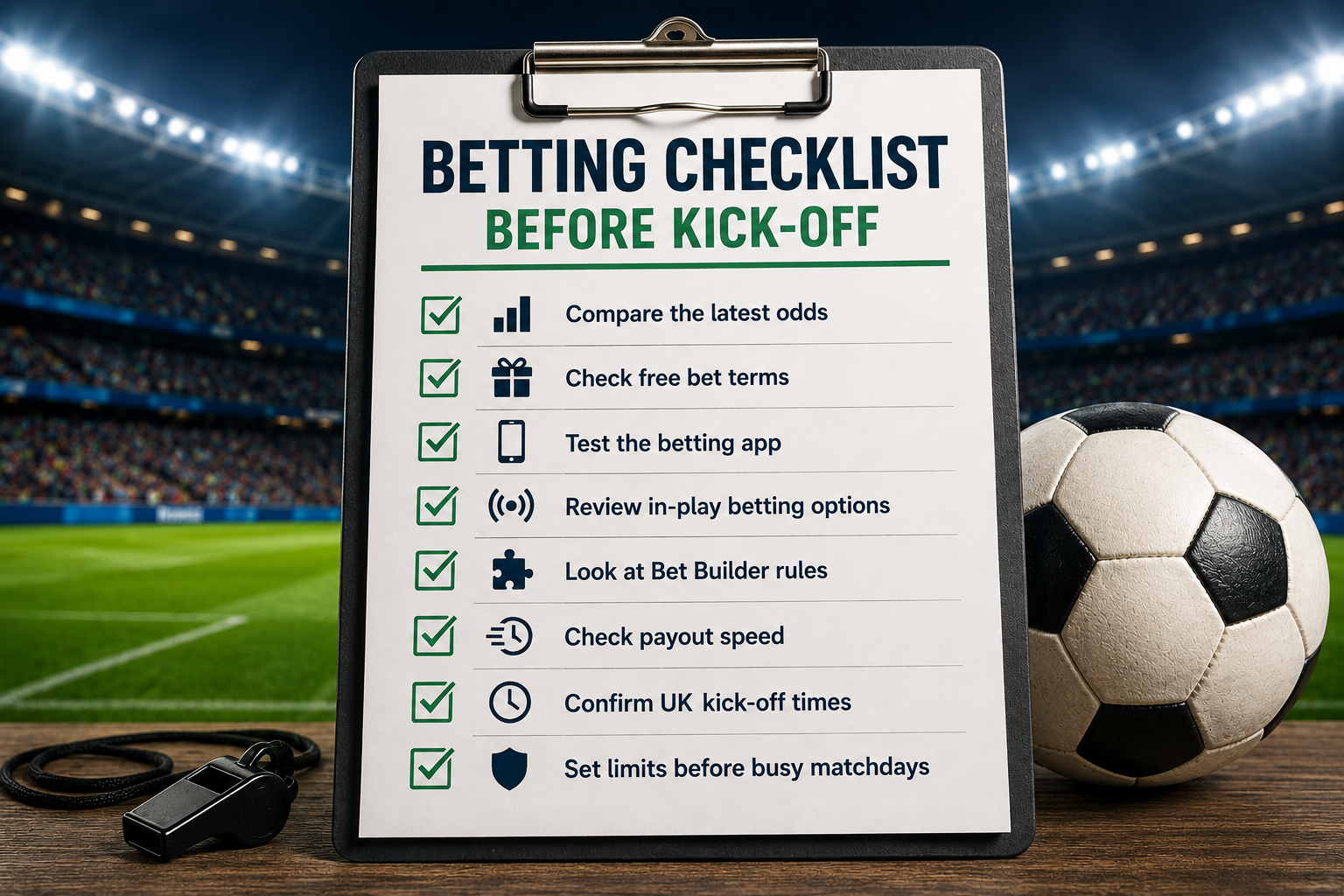
Draft pre‑match checklist for every Thai League 2017/2018 bet
- Team news: have you checked for injuries, suspensions, or clear rotation hints for both sides?
- Form: do the last 5–10 matches (league only) support the idea that one side is significantly stronger right now?
- Home vs away: what does the 2017 home/away table say about these teams in this venue?
- Head‑to‑head: are there any relevant recent meetings in the same stadium, with similar squads, and do they align with your view?
- Motivation: does one team clearly need points more (title race, AFC spots, or relegation fight), and could the other be content with a draw?
- Schedule: have either club played or will they play cup matches around this fixture, creating possible fatigue or rotation?
- Odds and market: do current prices on 1X2, handicap or totals differ from what you expected based on steps 1–6?
- Bankroll: does the intended stake respect your unit size and current profit/loss, with no “extra” money added because of emotion?
Working through these eight questions before every bet ensures that you look at the same types of evidence for Buriram vs Port as for a mid‑table clash or a relegation decider, rather than changing your process depending on how excited you feel about the match.
How to Embed the Checklist Into Your Use of UFABET
In practice, checklists compete with the speed and flexibility of online odds screens. Many Thai League bettors view fixtures and prices through unified digital tools that aggregate multiple leagues and markets. In that environment, a service like แทงบอลออนไลน์ is often used as a sports betting service where Thai League 2017/2018 matches sit alongside foreign games, live betting, and various lines. To keep your checklist at the centre, you have to invert the usual sequence: instead of opening the website first and deciding what to bet from the menu, you start with your own checklist offline or in a separate note, identify which Thai League fixtures (if any) pass all steps with a clear edge, and only then log in to place those specific bets. When you treat the service as a final execution step rather than as a place to look for ideas, you massively reduce the number of impulsive, checklist‑free bets that slip into your season.
Where casino online Contexts Undermine Checklists—and How to Defend Them
If your Thai League bets are placed inside a broader casino online website, the checklist has to compete with a design built around continuous, rapid decisions. Healthy‑gambling advice emphasises that structured habits like pre‑match routines become fragile when surrounded by one‑click games and constant prompts. Even if you start with a clear Thai League process, a few unplanned spins or side bets can shift your mindset toward action‑for‑its‑own‑sake, after which skipping a match that fails the checklist feels harder.
One defence is to create a strict boundary: your checklist applies to all football bets, and during a given Thai League round, you place only those wagers that pass it—without compensating by gambling elsewhere on the same site. If you notice that you routinely ignore your own rules once you are in the casino environment, that is a signal to step back and reconsider whether the broader setting is compatible with the disciplined Thai League approach you are trying to build.
Using the Checklist to Decide When Not to Bet at All
A checklist is not only about selecting bets; it is also a tool for saying “no”. Draw‑prediction frameworks and general betting‑strategy articles stress that some matches remain too balanced or too information‑poor even after analysis, and that the correct move is to walk away. In Thai League 2017/2018, that might be a mid‑table game with little at stake, unclear line‑ups, and odds that line up perfectly with your own estimates.
When several checklist items come back as “unclear” or “no edge”—for example, when team news is uncertain, motivation is low, and odds look efficient—the checklist has done its job by flagging the fixture as uninteresting from a value perspective. Training yourself to follow that signal—to watch without betting or to skip entirely—is arguably the single most important habit for long‑term Thai League betting health.
Summary
Across Thai League 2017/2018, a personal pre‑match checklist transforms betting from a series of isolated guesses into a repeatable process anchored in team news, form, context, and price. By defining clear steps, mapping them to common errors, and integrating the routine into how you use online odds screens and casino‑style environments, you give yourself a consistent way to decide not only which matches to back, but also which to leave alone, turning discipline into a practical, match‑by‑match habit.
